
The global email marketing market is valued at $13.72 billion in 2026 and projected to reach $22.93 billion by 2031. Automated emails already generate 30% of all email revenue from just 2% of total sends, earning 16x more per send than standard campaigns.
Advanced AI adopters are 75% more likely to achieve ROI above 45:1; production timelines have compressed from two weeks to three days, and only 47% of companies are currently designing fully responsive emails despite mobile being the dominant reading environment.
Email marketing in 2026 rewards the programs that have built the right infrastructure. The gap between those who have and those who haven’t is widening.
Top email marketing trends for 2026
Here are the key email marketing trends for 2026:
- Global average inbox placement for marketing email reached 87.2% in 2025, a 3.7 percentage-point year-on-year improvement.
- Automated emails generated 30% of all email revenue in 2025 from just 2% of total sends, earning 16x more per send than campaign emails.
- Only 43.9% of all emails processed globally actually reach a recipient’s inbox, with the remaining 56.1% blocked before delivery.
- Advanced AI adopters in email are 75% more likely to achieve an ROI above 45:1 compared to early-stage adopters.
- Welcome emails achieve an average open rate of 83.63%, the highest engagement of any automated email type.
- Only 47% of companies currently design fully responsive, mobile-friendly emails, despite mobile being the dominant email-reading environment.
- More than half of the most-visited domains worldwide still have no DMARC record, leaving them exposed to spoofing and deliverability penalties.
- Email delivers an average ROI of $36 for every $1 spent, rising to $45 in retail and ecommerce.
- Open rates in ecommerce rose for the fifth consecutive year, reaching 30.7% in 2025.
- The global email marketing market is projected to grow from $13.72 billion in 2026 to $22.93 billion by 2031.
Email deliverability benchmarks and trends
Global email deliverability improved meaningfully, but the picture is more divided than the headline number suggests.
Hostinger analyzed 1 billion emails processed through its platform in January 2026 and found that only 43.9% were successfully delivered, with the remaining 56.1% blocked by spam and virus filters.
The Validity Email Deliverability Benchmark Report measures something different: marketing email inbox placement for senders using established platforms. Both figures are accurate within their respective scopes, and together they show why the industry average appears healthier than the raw delivery picture.
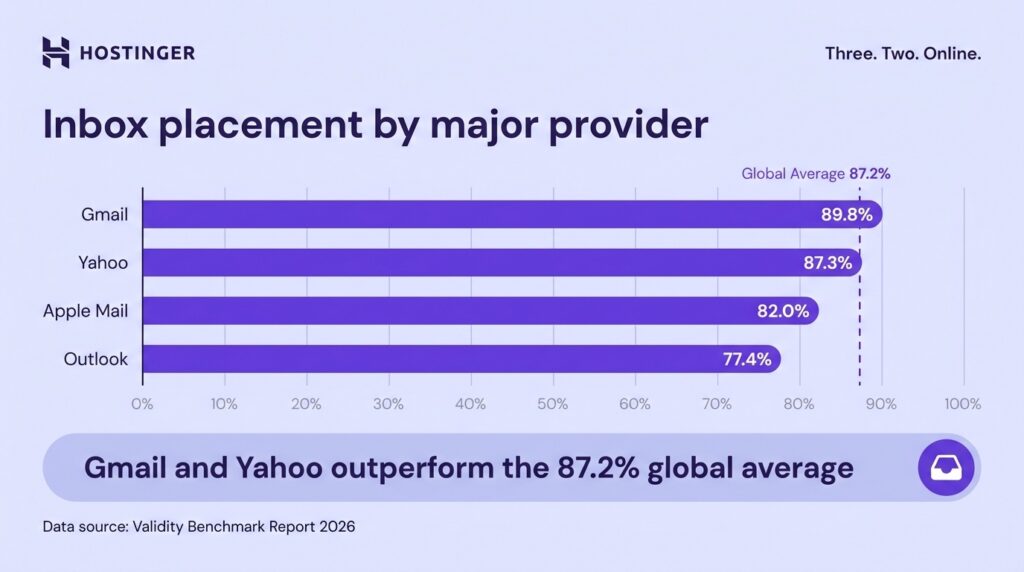
- The global average inbox placement for marketing email was 87.2% in 2025, a 3.7 percentage-point gain year-over-year (Validity).
- Inbox placement varied significantly by provider: Gmail at 89.8%, Yahoo at 87.3%, Apple Mail at 82.0%, and Microsoft/Outlook at 77.4%, provider-level divergence that makes platform-specific testing essential for senders targeting multiple inbox environments (Validity).
- Europe is the top-performing region, with an average inbox placement of 91.1%, and global sending volume fell year-on-year for the first time in Validity’s report history, suggesting senders are prioritizing list quality over volume (Validity).
- Average global spam complaint rate fell to 0.06% throughout 2025, below the 0.1% threshold now enforced by major providers (Validity).
- 66.2% of senders use both SPF and DKIM, but more than 25% are still unsure whether their domain is properly authenticated (Mailjet).
- More than half of the most-visited domains still lack a DMARC record, and of the 937,931 domains that do have one, over 56% remain on p=none, meaning no active protection against spoofing (EasyDMARC).
Senders who authenticate properly, maintain clean lists, and monitor their reputations are seeing real gains. For everyone else, the gap comes down to authentication and list hygiene, both of which are straightforward to address.
Email automation drives a disproportionate share of revenue
Automated emails are generating a concentrated share of total email revenue from a fraction of send volume, and two independent large-scale datasets confirm this pattern across different platform types.
- Across a broad sample of ecommerce senders, automated emails generated 30% of all email revenue in 2025 from just 2% of total send volume, earning $2.87 per send compared to $0.18 for standard campaign emails, a 16x per-send advantage (Omnisend).
- Open rates in ecommerce rose for the fifth consecutive year, reaching 30.7% in 2025, up from 26.6% in 2024 (Omnisend).
- Among Klaviyo’s more sophisticated ecommerce user base, automated flows generate approximately 41% of total email revenue from just 5.3% of sends, with revenue per recipient nearly 18x higher than campaign emails. Nearly 48% of flow revenue comes from new buyers (Klaviyo).
- Welcome emails achieve an average open rate of 83.63% and a click-through rate (CTR) of 16.60%, the highest engagement of any automated email type, with an unsubscribe rate of just 0.94% (GetResponse).
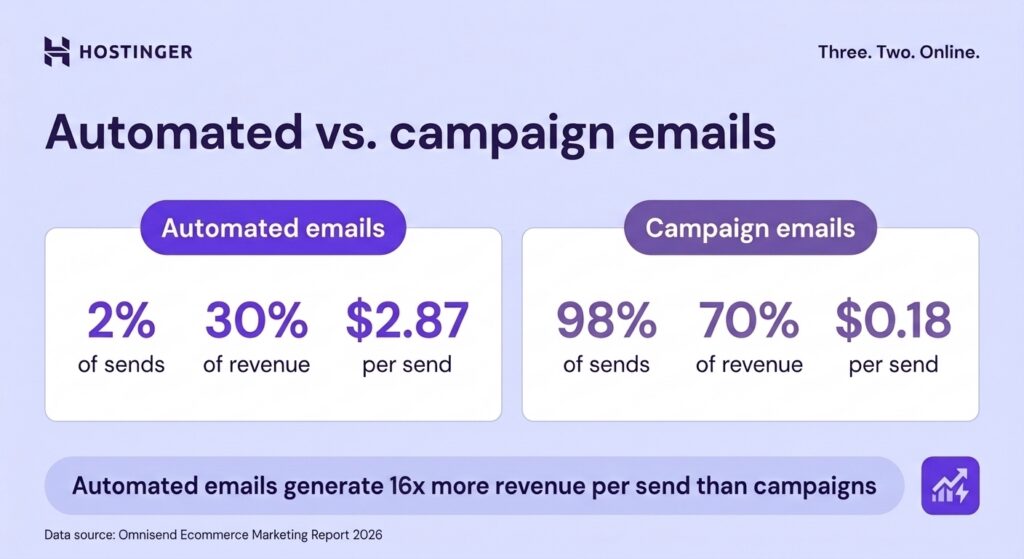
Two datasets, different platform types, same conclusion: a small share of sends is driving most of the revenue. For programs still relying primarily on broadcast campaigns, the data suggests the highest-ROI investment is building out the automation layer, not increasing send frequency.
AI is reshaping how email campaigns are built and measured
AI adoption in email marketing is showing up in production timelines and ROI gaps more than in adoption rates alone. Litmus surveyed 502 marketers across the US, UK, Australia, and New Zealand in late 2025, and found the following:
- Generative AI is the most impactful AI use in email marketing, cited by 22% of marketers, ahead of personalizing content (15%), campaign analysis (15%), and improving deliverability (12%).
- 76% of marketing teams now produce and send a marketing email within 3 days. In 2024, 62% of teams took two weeks or more for a single email, a structural shift in how quickly programs can now execute.
- Advanced AI adopters are 28% more likely to deploy an email in under a day (37% vs 28% for early-stage teams).
- 35% of email teams now list AI and machine learning skills as their top hiring requirement for the year ahead, overtaking content creation, which held that position in 2025.
- 33% of email marketers expect more than half of their operations to be AI-driven by end of 2026; 11% expect over 75% AI-driven operations.
The compression of production speed from two weeks to three days is the clearest proof of AI’s real-world impact. The teams seeing the highest returns are the same ones using AI not just to speed up production, but to optimize for value per send. That is why the gap widens at the top of the distribution.
Personalization and segmentation are moving from tactics to infrastructure
Personalization in email is no longer a campaign enhancement. The shift toward email list segmentation as an always-on practice is playing out most clearly in email, where targeting directly determines whether messages are delivered, opened, and converted.
The data shows a widening divide between programs using real-time behavioral triggers and those relying on demographic segmentation alone:
- Companies with ROI above 45:1 are 20% more likely to use subscription lifecycle emails and 20% more likely to use behavioral segmentation triggers than average-performing programs (Litmus).
- Nearly 48% of automated flow revenue comes from new buyers, with welcome, browse abandonment, and abandoned cart flows serving as the primary first-purchase conversion tools (Klaviyo).
- B2C email marketers are 25% more likely to prioritize personalization and dynamic content creation skills in 2026 hiring plans (Litmus).
- 86.4% of marketers now use AI tools, with email cited as one of the channels where AI has most improved campaign performance (HubSpot).
The revenue gap between teams with real-time behavioral triggers and those using static segmentation is now consistent across multiple independent datasets. Personalization has quietly become the factor that separates high-growth programs from those that have hit a ceiling.
Expert tip
AI has removed the main barrier to personalization at scale. Any team can now build behavioral segmentation and lifecycle triggers without a dedicated analyst or a complex tech stack. The programs seeing the highest returns are the ones that have already made that shift.

The metrics email marketers track are changing
How email performance is measured is shifting as quickly as how campaigns are built. Apple Mail Privacy Protection (MPP) accelerated open rate inflation, but the change runs deeper than one privacy update. The data shows a clear directional move toward revenue attribution and lifetime value across the industry.
- 57% of email marketers currently measure performance through subscriber engagement metrics; 52% use MQL and conversion rates; 47% use broader KPIs, including retention and lifetime value (LTV); 44% use direct revenue attribution. Only 7% do not currently measure email’s contribution to business goals (Litmus).
- Multi-channel attribution and MQL measurement jumped 22% year-on-year. B2B teams are 39% more likely to use multi-channel attribution than B2C (46% vs 33%) (Litmus).
- Nearly half of all marketers (47%) report average open rates between 20% and 40%. Litmus recommends treating open rates as a directional trend signal post-MPP, rather than an absolute performance metric (Litmus).
The measurement shift is not arbitrary. The teams holding email accountable for pipeline, revenue, and LTV are reporting the highest ROI. What gets measured gets optimized, and open rates alone no longer capture the full performance picture.
Mobile-first and accessible design are becoming compliance requirements
Mobile is already the dominant email environment, but the design gap between what mobile users need and what most programs deliver remains significant.
In 2026, accessible and responsive email design is a legal requirement for a substantial share of global senders, following the European Accessibility Act (EAA), which came into force in 2025.
- Only 47% of companies are currently designing fully responsive, mobile-friendly emails, despite mobile being the dominant reading environment (Litmus).
- Only 26% of organizations follow WCAG accessibility standards, and only 21% comply with the European Accessibility Act (EAA). Advanced AI adopters are 54% more likely to follow WCAG and 52% more likely to comply with the EAA (Litmus).
The EAA applies to businesses with 10 or more employees operating in or selling to EU consumers, making compliance a legal baseline for a significant share of global senders. Most teams are still implementing accessibility tactics in isolation rather than following comprehensive standards like WCAG, which carries both legal and engagement risk.
Email marketing ROI and market growth in 2026
Email marketing maintains its position as one of the highest-ROI digital channels in 2026, and market projections reflect continued investment in the channel at scale.
- Email delivers an average ROI of $36 for every $1 spent, with the retail and ecommerce sector averaging $45 per $1 (Litmus).
- Advanced AI adopters are 75% more likely to achieve an ROI of 45:1 or more than early-stage teams (Litmus).
- The global email marketing market is projected to grow from $13.72 billion in 2026 to $22.93 billion by 2031 at a 10.82% compound annual growth rate (CAGR). North America held 40.93% of the global revenue share in 2025 (Mordor Intelligence).
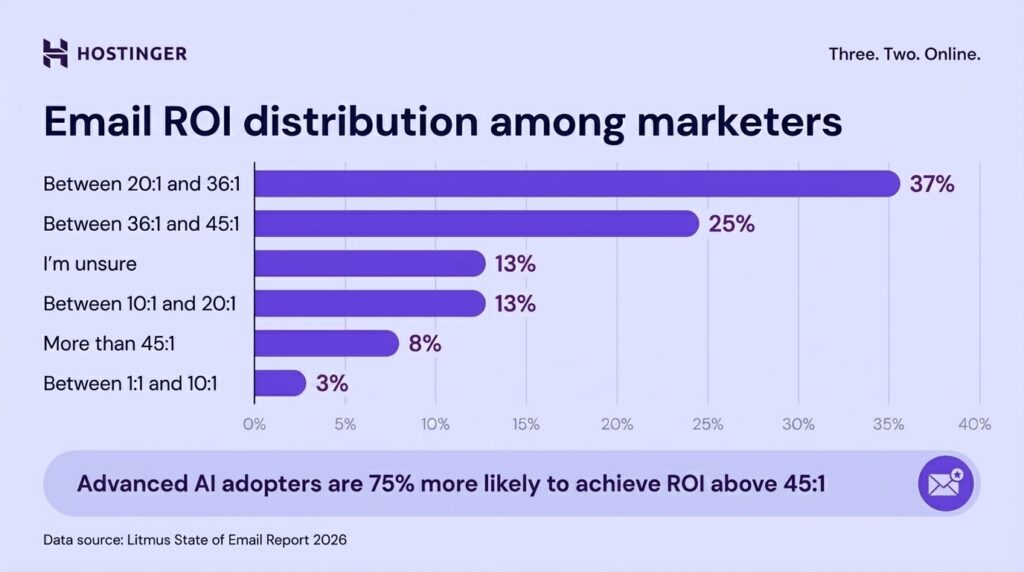
The average ROI figure is useful context, but the distribution data tells a more actionable story. The top 8% of programs, those achieving above 45:1, share characteristics that appear consistently across multiple datasets: advanced automation, behavioral segmentation, AI-assisted production, and proper authentication.
The average masks a wide spread, and the gap between the top and the median is growing, a pattern that runs across Hostinger’s email marketing statistics on open rates, send frequency, and platform performance.
What are the key email marketing trends for 2026?
The biggest shifts in 2026 come down to three things: AI, authentication, and automation.
Inbox providers are deploying AI to sort, summarize, and filter email before it reaches readers, making relevance and authentication prerequisites for visibility rather than differentiators. Programs that treat these as mere technical checkboxes will face growing losses in deliverability and engagement.
Revenue is concentrating on automation flows, and the gap between sophisticated and basic email programs is widening. A program running welcome, abandonment, and lifecycle flows on a clean, authenticated list is structurally different from one sending broadcast campaigns to unmanaged lists.
Accessibility and authentication requirements are also expanding globally, with the EAA setting a precedent for broader regulatory attention to digital communication standards. With approximately 392.5 billion emails sent every day, standing out in the inbox has never been more competitive.
For businesses looking to put this into practice, Hostinger Reach covers authentication, automation, and accessible design without requiring a dedicated technical team on your end.
The post Email marketing trends in 2026: Data and insights appeared first on Hostinger Blog.
Article source: https://www.hostinger.com/blog/email-marketing-trends